


Company Introduction

We make micro air pumps in [city, country]. The company was founded in [year], and the factory covers [area] m² with [number] assembly lines and R&D engineers. Around [number]% of what we build is exported, mostly to the US and EU. Our customers include medical device makers, analyzer brands, automation integrators and beauty-equipment brands.
We hold ISO 9001 certificationand have CE, RoHS and REACH documents for the pump families that carry them. Copies are on this page, so you don't have to fill in a form to see them.
Every pump is tested before it ships. We measure free air flow, ultimate vacuum, current draw and noise at 30 cm. From each batch, one pump goes onto an aging bench running 10 s on, 2 s off. All our micro vacuum pumps are assembled and tested in our own factoryResults are filed by lot number, so if a customer reports a problem, we can trace that pump back to its batch.
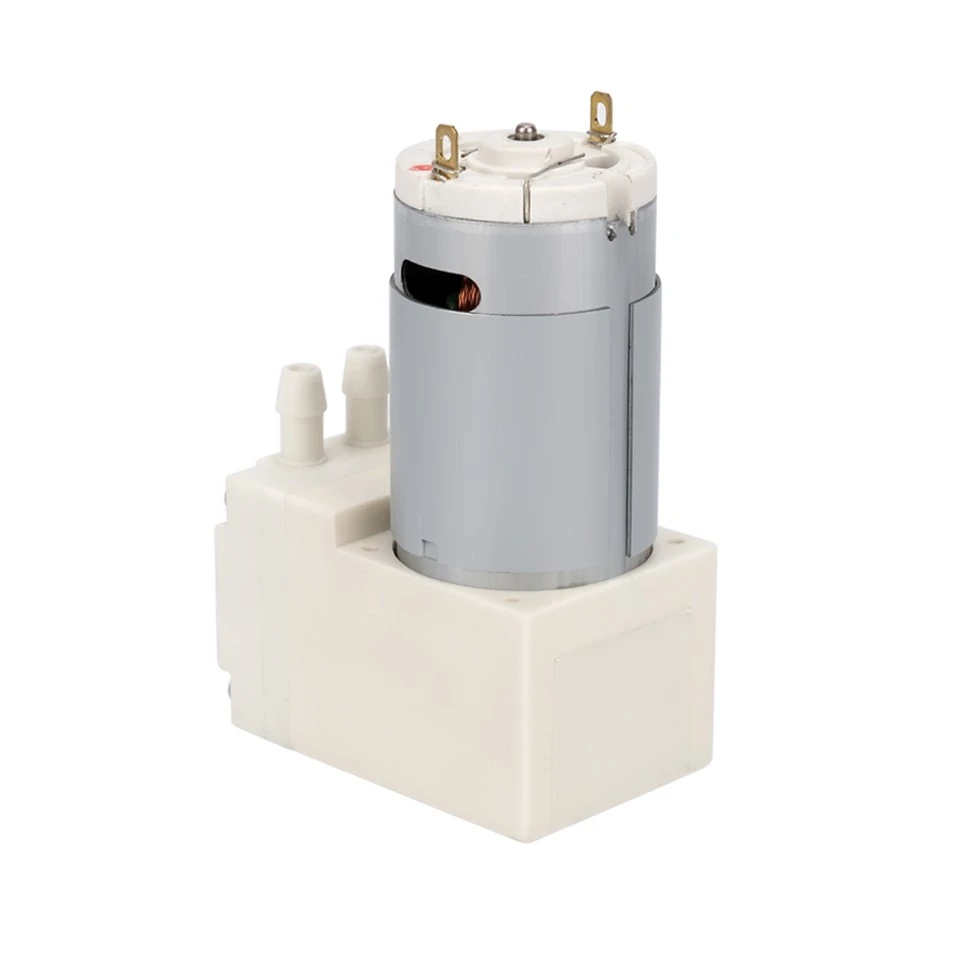
Oil-Free Micro Air Suction Pump Specifications
These are our standard oil-free micro vacuum pump models. All values were measured at rated voltage and 25 °C on clean, dry airMVP-12A: 12V DC, max 450 mA, 2.8 L/min free air flow, –58 kPa ultimate vacuum, 58 dB at 30 cm, 5,000 h rated life (intermittent), 85 g, 61 × 27 × 35 mm.
MVP-24A: 24V DC, max 250 mA, 2.8 L/min, –58 kPa, 58 dB, 5,000 h, 85 g, 61 × 27 × 35 mm.
MVP-12B: 12V DC, max 800 mA, 6.0 L/min, –75 kPa, 60 dB, 4,000 h, 200 g, 86 × 66 × 40 mm.
MVP-BL12: 12V DC brushless, max 350 mA, 3.0 L/min, –60 kPa, 55 dB, 8,000 h, 95 g,
The MVP-12A is our 12V DC model and the MVP-24A is the 24V version of it. If you need a deeper vacuum, look at the MVP-12B. Vacuum values are gauge pressure. Ports are 4 to 6 mm hose barbs, and the working temperature range is 0 to 50 °C. Diaphragm and valves are EPDM as standard. FKM and PTFE are available as options.
A lubricated pump puts oil vapor into the air stream. That vapor ends up in sensors, sample bags and patient-side tubing, where nobody wants it. An oil-free diaphragm pump doesn't have this problem. An eccentric drive moves a flexible diaphragm, which changes the chamber volume, and two check valves keep the air moving in one direction. The air touches only the diaphragm and the valves, and neither needs oil.
In practice you get no oil mist in the exhaust, no oil changes, and fewer clogged filters downstream. It isn't maintenance-free, though. The diaphragm is a wear part and has to be replaced at the end of its rated life. We supply a replacement kit for each model.
Flow falls as vacuum gets deeper, and this is usually the first curve engineers ask for. For the MVP-12A at 12V: 2.8 L/min at 0 kPa (free air), L/min at –20 kPa, [value] L/min at –40 kPa, and [value] L/min at –55 kPa.
We measure flow and vacuum with a calibrated flow meter and vacuum gauge. Noise is measured at 30 cm in a [quiet room / semi-anechoic chamber and logged in dB(A). Life tests run at 10 s on, 2 s off with clean dry air, and we stop when flow drops below [80]% of its starting value. Every pump goes through the same test sequence. If you need third-party material reports or RoHS/REACH reports, we can supply them.
Compatibility
The pumps run on regulated 12V or 24V DC. Most models accept simple on/off switching or PWM speed control. The brushless MVP-BL12 takes an analog or PWM input, so it connects directly to an Arduino, a PLC or your own control board. Startup current is higher than running current, so size your power supply with some margin.
These pumps are for clean air and non-corrosive, non-condensing inert gases. They are not for liquids, strong corrosive gases, or air carrying dust. If moisture or aerosol can reach the inlet, put a liquid trap, a hydrophobic filter and a check valve upstream. Most of the early failures we see come from skipping this.
The barbs fit silicone or medical-grade tubing with a 4 to 6 mm inner diameter. Mounting brackets or threaded holes allow horizontal or vertical installation. We have 2D and 3D drawings, and for OEM projects we can change the port orientation.
For materials, the standard diaphragm and valves are EPDM. You can switch to FKM or PTFE for better chemical resistance and a wider temperature range, and the valves should match the diaphragm. The pump head is engineering plastic as standard, with PPS available for better dimensional stability. Tell us the exact gas mixture before you pick a material. If a pump is wrong for your media, we'll tell you so, because a pump that fails in three months is bad for both of us.
Customization
We adapt the parts that matter for your product: voltage from 3 to 24V DC, target flow and vacuum, port size and direction, wire length and connector, noise damping, an integrated driver board, your logo and your packaging. Brushless motors and special diaphragms are requests we get often.
The process goes like this. First we review your requirements: flow, vacuum, duty cycle, media and noise target. Then we send a technical proposal and quotation. Prototype samples follow about weeks after confirmation. You test them, and our engineers are available for questions. After that comes a pilot run and final validation, and then volume production.
Standard models are available as samples in small quantities. For OEM orders, the MOQ is [500 to 1,000] pieces, depending on how much we change. For pilot projects we can talk about lower numbers. Wholesale buyers can mix models within one order [confirm]. Production lead time after sample approval isWe provide [CE, RoHS and REACH] documents for the models that carry them, along with material certificates and process records. If your market needs extra testing, let us know early so we can plan it into the schedule.
Ready to evaluate a pump for your design? Send us your flow, vacuum, voltage and noise targets. Our engineers will recommend a model or quote a custom version.
FAQ
Q: What is an oil-free micro air suction pump?
A: It's a small diaphragm pump that creates vacuum without lubricating oil. The diaphragm separates the motor side from the gas path, so the air stays clean. That's why you see these pumps in medical, analytical and electronics products.
Q: How long does an oil-free micro vacuum pump last?
A: Our brushed models are rated at [4,000 to 5,000] hours of intermittent duty, and the brushless model at [8,000] hours. Continuous running, high temperature and dirty air all shorten that. A replacement diaphragm kit extends the pump's service life.
Q: Can it run continuously?
A: Some models can, within their rated temperature and current. Check the continuous-duty rating of the specific model and leave some airflow around the housing. If you plan to run 24/7, tell us and we'll recommend the right version.
Q: What's the difference between a diaphragm pump and a piston pump?
A: A diaphragm pump seals with a flexible membrane and is oil-free by design. A piston pump can reach higher flow or pressure in some sizes, but its piston seals wear differently. For clean, quiet vacuum in a small device, a diaphragm pump is usually the better fit.
Q: Can a micro vacuum pump handle liquids or corrosive gases?
A: No. Liquids and aggressive chemicals damage the diaphragm, valves and motor. If moisture is possible, add a liquid trap and a hydrophobic filter before the inlet.
Hot Tags: oil free micro air suction pump, China oil free micro air suction pump manufacturers, suppliers, factory, DC Water Pump In Aquarium Water Pumps, Small Volume Dispenser Peristaltic Pumps, flexcom original automatic fuel fluid water siphon pump, gasoline syphon pump, 12v dc aquarium water pump, liquid injection pump


