


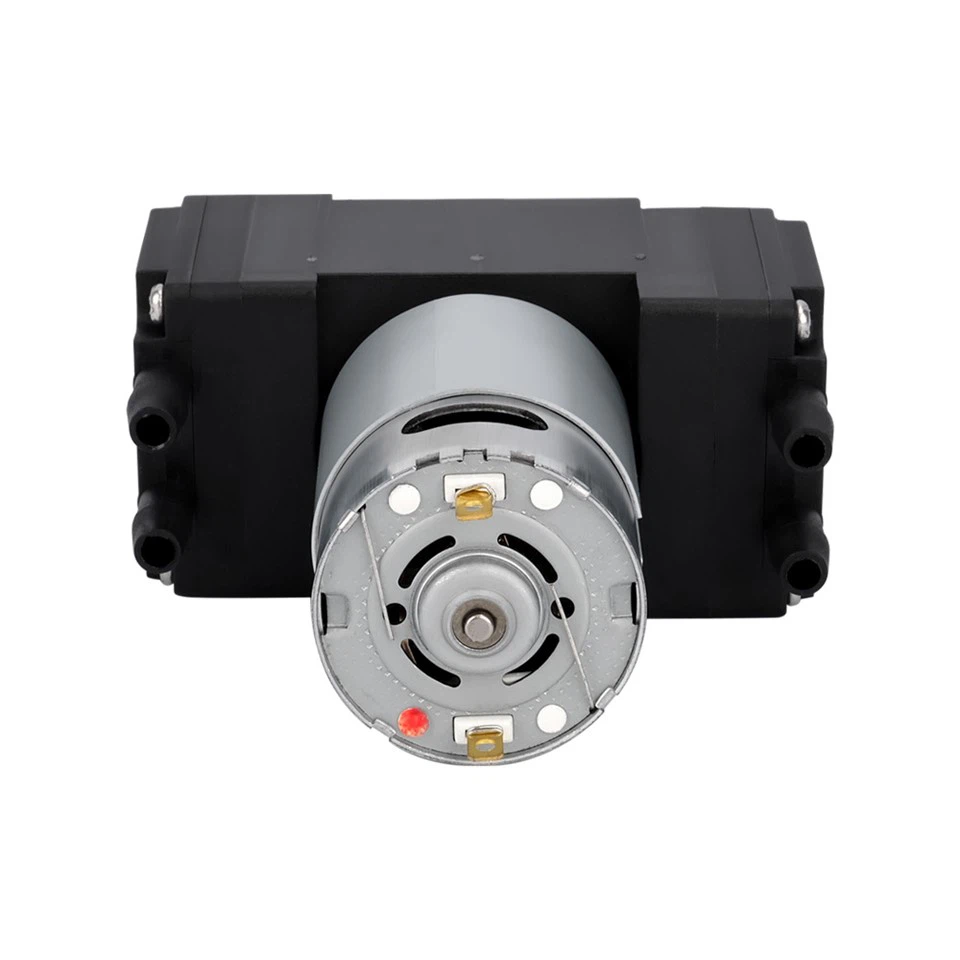
Device Selection
The most common source of integration trouble is starting with a pump datasheet instead of the actual device requirements. Experienced engineers reverse the process: define what the equipment needs, then select the pump that fits those constraints.
Begin with the application, not the pump
Quantify the target vacuum or operating pressure, the volume of the gas path or chamber, the expected duty cycle, the physical space available and the power supply. Only after those numbers are clear does it make sense to look at flow curves, ultimate vacuum, voltage options and diaphragm materials. This approach prevents both oversizing and under-performance.
Match the pump to the device type
|
Device Type |
Typical Vacuum / Flow Need |
Noise Priority |
Practical Direction |
|
Blood-pressure monitors / medical suction |
–60 to –80 kPa, 2–8 L/min |
Very high |
Low-noise brushless, single-head |
|
Gas sampling & analyzers |
–40 to –70 kPa, 1–5 L/min |
High |
Compact 12 V DC, chemical-resistant diaphragm |
|
Coffee machines / food vacuum |
–50 to –70 kPa, 5–15 L/min |
Medium |
Dual-head for higher flow, EPDM |
|
Laboratory filtration |
–70 to –90 kPa, 3–10 L/min |
Medium |
Higher-vacuum oil-free models |
|
Vacuum pick-and-place / suction cups |
–60 to –85 kPa, 4–12 L/min |
Medium–high |
Robust mounting with vibration isolation |
Estimate pump-down time
A workable first approximation is:
t ≈ (V / S) × ln(P₁ / P₂)
where V is chamber volume in litres, S is the average effective pump speed over the pressure range, P₁ is starting pressure and P₂ is the target.
Take a 0.8 L manifold starting at atmospheric pressure and aiming for –70 kPa gauge (approximately 31 kPa absolute). With an effective average flow of 4 L/min the calculation gives about 14–15 seconds under ideal conditions. Real systems usually add 20–40 % because of tubing restrictions, temperature effects and residual leaks. Always confirm with a prototype rather than relying solely on the formula.
Voltage, size, mounting and noise
Most designs run on 12 V or 24 V DC. Check continuous current under load, not just no-load figures. Physical dimensions and weight must fit the allocated space; many units accept both horizontal and vertical mounting, yet vibration isolation is often required to keep installed noise in the 45–55 dB(A) range at one metre. Catalogue noise values are free-field measurements-actual results after installation can differ noticeably.
Frequent selection mistakes
Selecting purely on the highest published ultimate vacuum while ignoring flow at the actual operating pressure is the most common error. Other recurring problems include overlooking duty-cycle limits (continuous operation may need derating or a brushless motor), choosing the wrong diaphragm material for moisture or mild solvents, under-estimating the effect of inlet restrictions, and ignoring how mounting orientation transmits vibration into the final housing.
Send the key equipment parameters-target vacuum, volume, duty cycle, voltage, noise limit and process media-and the application team can suggest suitable small diaphragm vacuum pumps and supply evaluation samples at no charge.
What is the difference between small diaphragm vacuum pumps
Understanding the practical differences helps set realistic expectations.
Diaphragm, piston and rotary-vane comparison
|
Characteristic |
Diaphragm |
Piston |
Rotary Vane |
|
Oil requirement |
Oil-free |
Often oil-lubricated |
Usually oil-lubricated |
|
Noise |
Low to moderate |
Higher |
Moderate to high |
|
Service life |
Long with correct material |
Medium |
Medium to long |
|
Ultimate vacuum |
–50 to –90 kPa typical |
Can go deeper |
Can go deeper |
|
Maintenance |
Minimal |
Periodic seal work |
Oil changes and vanes |
|
Relative cost |
Low to medium |
Medium |
Higher |
Oil-free small diaphragm vacuum pumps suit applications where contamination risk, noise and compact size matter more than the deepest possible vacuum.
Brushed versus brushless motors
Brushed motors keep the unit cost lower and work well for intermittent duty. Brushless versions typically deliver longer life, lower electromagnetic noise and better efficiency, which makes them preferable for medical devices or instruments that run for long periods. The price difference is real; the decision usually comes down to expected operating hours and noise targets.
Single-head and dual-head layouts
A single head offers the best balance of vacuum and flow in the smallest package. Dual-head designs can be wired for higher free flow (parallel) or improved vacuum recovery (series). Choose according to whether flow rate or ultimate vacuum is the dominant requirement.
Diaphragm and valve materials
EPDM covers most general-purpose needs and handles temperatures roughly from –20 °C to +100 °C. FKM provides better chemical and higher-temperature resistance. Silicone remains flexible at low temperatures but has limited chemical resistance. PTFE-coated or composite diaphragms appear when the media are more aggressive or longer life is required. Matching the elastomer to the process gas-and to any occasional condensate-has a direct effect on service life.
When these pumps are not the right choice
Small diaphragm vacuum pumps are not suitable for high-vacuum work below about 1–5 mbar absolute, continuous high-flow industrial processes measured in hundreds of litres per minute, or systems that routinely ingest large volumes of liquid water or abrasive particles. In those cases other technologies are more appropriate. Stating the limits clearly protects both the end product and the supplier's credibility.
Quality Control and Testing
Consistent performance depends on disciplined testing rather than claims.
In-house test capability
The lab runs vacuum gauges, mass-flow meters, leak-test stations, sound-level meters, life-test racks and environmental chambers. Multiple stations allow simultaneous checks of ultimate vacuum, free flow, closed-head performance, current draw, noise and long-term endurance.
Production process
Incoming inspection covers diaphragms, valves, motors and critical moulded parts. In-process checks monitor assembly torque, seal integrity and electrical parameters. Every finished unit receives 100 % performance testing for ultimate vacuum, free-flow rate, current and basic airtightness before packaging.
Life testing and reliability
Life tests run under defined voltage, duty cycle, temperature and load conditions. Durations range from several thousand to tens of thousands of hours according to the model family. Failure criteria include vacuum drop beyond a set percentage, excessive noise or current, or diaphragm rupture. Where MTBF figures appear, the calculation method and confidence level are stated.
Batch consistency
Each production batch carries a unique identifier linked to material lots and test records, supporting root-cause analysis and giving customers documented evidence of consistency.
|
Test Item |
Method / Standard |
Acceptance Criteria |
Outgoing Check |
|
Ultimate vacuum |
Closed-head, calibrated gauge |
Within model specification |
100 % |
|
Free-flow rate |
Mass-flow or volume method |
Within model specification |
100 % |
|
Leak / airtightness |
Pressure-decay or vacuum hold |
Below defined leak rate |
100 % |
|
Noise |
Sound-level meter at 1 m |
Below catalogue or customer limit |
Sample + critical models |
|
Life / endurance |
Continuous or cyclic operation |
Meets design hours without failure |
Sample |
|
Temperature cycling |
Environmental chamber |
Performance within limits after cycle |
Sample |
Why choose us
Engineering support for integration
Application engineers help with parameter matching, sample evaluation and practical recommendations on mounting and tubing. Early involvement shortens development time and reduces the risk of late-stage changes.
OEM and custom options
Voltage (including common 12 V DC variants), flow and vacuum targets, port fittings, wire harnesses, diaphragm material, labelling and packaging can be adapted. Minimum order quantities, sample lead times and production schedules are discussed against the actual project scope.
Certifications
CE, RoHS and REACH documentation is supplied. Specific certificate numbers and test reports are available on request.
Export experience and support
Regular shipments reach Europe, North America and other regions. Warranty terms, spare-parts availability and response commitments are defined in the commercial agreement.
Application experience
Projects have included quieter 12 V operation for medical devices, chemical-resistant configurations for gas analyzers and dual-head layouts for higher-flow food-equipment applications. Detailed case data can be shared under NDA when relevant to a new enquiry.
As a manufacturer focused on small diaphragm vacuum pumps, the priority is technical dialogue that leads to a reliable match rather than pure transactional supply.
FAQ
Q: How do I choose a small diaphragm vacuum pump for my device?
A: Define the required vacuum level, chamber volume, duty cycle, available space, voltage and noise limit first. Estimate pump-down time, then compare flow and vacuum curves against those numbers. Share the parameters and suitable models plus evaluation samples can be recommended.
Q: What is the difference between a small diaphragm vacuum pump and a piston vacuum pump?
A: Diaphragm units run oil-free, are generally quieter and need less maintenance, which suits medical, analytical and food-contact applications. Piston pumps can sometimes reach deeper vacuum but often introduce oil or higher noise and wear.
Q: Can a small diaphragm vacuum pump run continuously?
A: Many models support continuous duty when kept within rated voltage, temperature and load limits. Brushless versions and adequate heat dissipation improve reliability under continuous operation. Always confirm the specific duty-cycle rating for the chosen model.
Q: How long does a small diaphragm vacuum pump last?
A: Service life depends on motor type, diaphragm material, duty cycle and operating conditions. Laboratory life tests commonly run from several thousand to tens of thousands of hours. Real-world life is best verified by application-specific endurance testing.
Q: How noisy are these pumps, and how can noise be reduced?
A: Catalogue figures are typically 40–55 dB(A) at one metre under free-field conditions. Installed noise can be lowered with vibration isolation mounts, soft tubing, acoustic enclosures and by selecting brushless or dual-head configurations optimised for lower vibration.
Q: Can the pump handle moisture or corrosive gases?
A: Standard EPDM diaphragms tolerate limited moisture. For corrosive or solvent-laden gases, FKM or PTFE-based materials are the better choice. Liquid water should be kept out of the pump with traps or filters; continuous liquid ingestion shortens life.
Q: How is each pump tested before shipment?
A: Every unit undergoes 100 % functional testing for ultimate vacuum, free-flow rate, current draw and basic airtightness. Additional sample testing covers noise, life and environmental performance according to internal protocols.
Hot Tags: negative positive pressure pump, China negative positive pressure pump manufacturers, suppliers, factory, dry scroll vacuum pump, pump vacuum pressure, evac vacuum pump, small electric tire pump, rotary screw vacuum pump, high vacuum oil


