


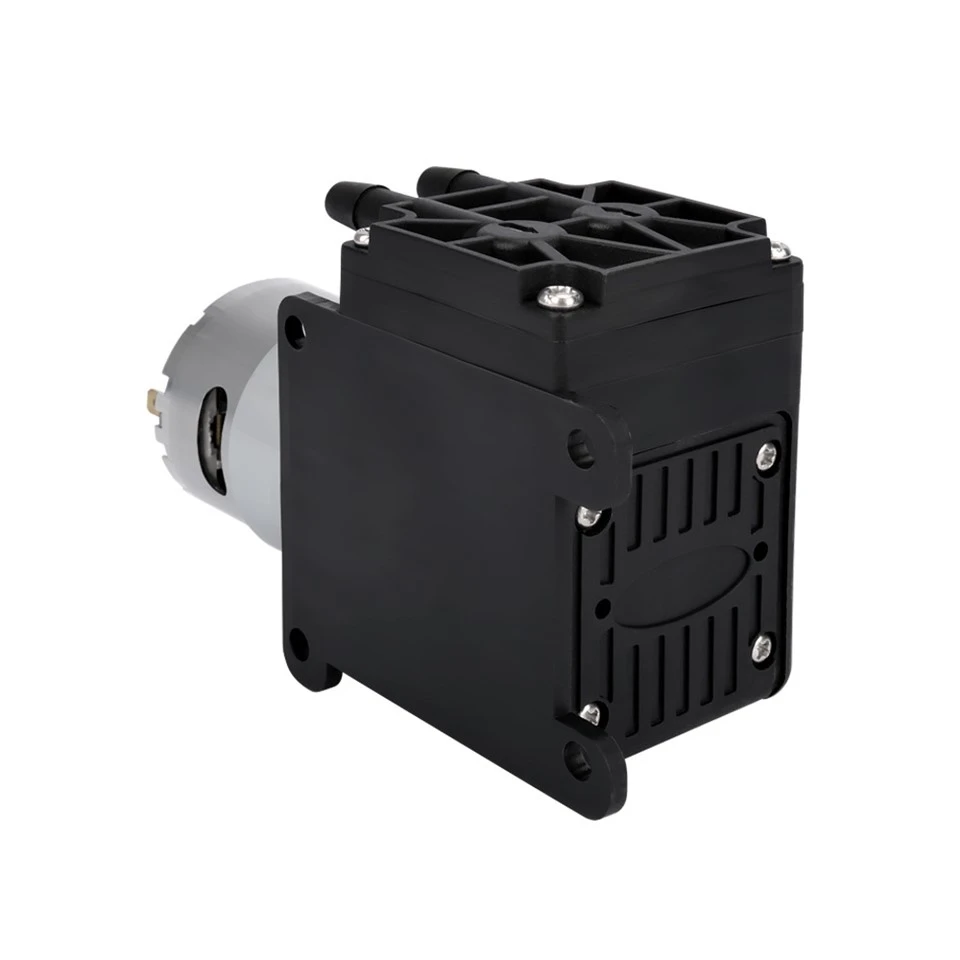


Performance
A 12V micro vacuum pump has to do one thing reliably: hold stable vacuum output while the actual supply voltage drifts, because a 12V rail is rarely a clean, flat 12.0V. Car batteries sit anywhere from 12.6V at rest to over 14.4V while the alternator is charging. Solar battery banks swing with charge state. If a pump's performance curve falls apart outside a narrow input window, it's not really a 12V pump - it's a pump that happens to be rated 12V on paper.
Our standard performance range
|
Parameter |
Specification |
|
Rated voltage |
DC 12V |
|
Operating voltage range |
10.5V – 15V |
|
Rated current |
0.25–0.45 A |
|
Max vacuum level |
Up to -70 kPa |
|
Free flow rate |
1.8–4.5 L/min |
|
Duty cycle |
30% ED to continuous, model-dependent |
|
Noise level |
≤44 dB(A) at 1 meter |
In real-world testing across that 10.5V–15V window, flow rate variance stays under 8%, which is the number that actually matters if your device runs off a car battery through a full charge-discharge cycle rather than a lab bench power supply. That's the kind of detail a spec sheet alone won't tell you, but it's the difference between a pump that works in the field and one that only works in a datasheet.
How It Works
The pump uses a self-priming diaphragm mechanism driven by a brushed or brushless DC micro motor, wound specifically for 12V input rather than a stepped-down 24V design. That distinction matters more than it sounds. A 24V motor run at half voltage through a buck converter will often start reliably but lose torque under load - which shows up as reduced vacuum level exactly when your device needs it most. Winding the motor for native 12V operation avoids that failure mode entirely.
The diaphragm compound (fluorosilicone or NBR, selected by application) flexes against a sealed chamber to draw negative pressure, cycling as fast as the motor's rated RPM allows. On the electrical side, the driver circuit is matched to expect the voltage ripple of a real 12V DC vacuum pump application - alternator noise, solar charge controller switching, battery management system load-shedding - rather than the clean DC input most bench-tested pumps are designed around.
The result is a pump that behaves the same way at 12.1V on a discharging battery as it does at 14.2V under charge, which is the actual operating condition for most 12V DC systems in the field.
Key Advantages
Stable output across real voltage swings. This 12V micro vacuum pump is designed natively for 12V rather than adapted from another voltage class, so flow rate and vacuum level stay consistent through the full operating range instead of only performing well at the exact rated voltage.
Lower current draw per unit of vacuum produced. At 0.25–0.45A rated current, this pump pulls meaningfully less from a battery system than a mismatched 24V unit running through a step-down converter, which loses efficiency at every conversion stage.
Compact footprint built for tight installations. Car dashboards, solar controller enclosures, and RV equipment bays all share the same problem - limited space - and this pump's housing dimensions were set with that constraint in mind rather than as an afterthought.
Verified batch consistency. Running continuous production for automotive and solar-adjacent applications, we check current draw and vacuum level at the batch level, not just on approval samples, so unit 1 and unit 10,000 perform the same way.
Customization
Standard 12V micro vacuum pump configurations cover most applications, but sourcing teams often need something adjusted for a specific installation. We support customization across a defined range:
Voltage fine-tuning within the 12V family (10V, 12V, 13.8V nominal variants)
Wiring harness length and connector type to match existing vehicle or panel wiring
Inlet/outlet port size and orientation for space-constrained housings
IP-rated sealing for outdoor, marine, or under-hood installations
Custom bracket or PCB-mount base to fit an existing enclosure
For buyers evaluating this as a recurring supply line rather than a single design-in, our engineering team reviews the target application before quoting tooling or MOQ requirements, since a wiring harness change and a full motor re-spec carry very different lead times and minimum order thresholds.
FAQ
Q: How many amps does a 12V micro vacuum pump draw?
A: Standard configurations draw between 0.25A and 0.45A at rated voltage, depending on the specific flow rate and vacuum level target. Actual draw can run slightly higher during startup and under higher back-pressure loads, so we recommend sizing wiring and fuses with at least 20% headroom above the rated current.
Q: Can this pump run directly on a car battery?
A: Yes. It's designed for the voltage range a car battery actually produces - 10.5V to 15V - including the higher voltage present while the alternator is charging, so it doesn't need a separate voltage regulation stage for most vehicle applications.
Q: What's the minimum order quantity for a 12V micro vacuum pump?
A: Standard configurations start at 500 units. Custom voltage variants, wiring harnesses, or IP-rated sealing typically raise the MOQ due to tooling and validation requirements - we'll confirm the exact number once we understand your specification.
Q: How is this different from a 24V micro vacuum pump run through a converter?
A: A native 12V motor winding avoids the efficiency loss and torque drop that come with stepping down a 24V unit through a buck converter. It also removes one failure point (the converter itself) from the overall system.
Q: What's the expected lifespan of a 12V micro vacuum pump under continuous use?
A: Life expectancy depends on duty cycle and operating vacuum level, similar to any diaphragm pump. Intermittent-duty configurations are rated for tens of thousands of cycles under normal load; we can share continuous-run life cycle test data for your specific configuration on request.
Q: Is this pump suitable for solar power systems?
A: Yes, it's a common fit for solar-powered devices where battery voltage fluctuates with charge state and time of day. The 10.5V–15V operating window is set specifically to handle that kind of voltage variability.
Q: Can I get this 12V micro vacuum pump through a wholesale or factory-direct order?
A: Yes. As a factory-direct manufacturer, we work with buyers on wholesale volume pricing once the configuration and MOQ are confirmed, rather than routing through a separate distribution layer.
Hot Tags: 12V Micro Vacuum Pump, China 12V Micro Vacuum Pump manufacturers, suppliers, factory, hk vacuum pump, dual stage rotary vane vacuum pump, oil lubricated vacuum pump, sublimation pump, drainage suction pump, oil less rocking piston pump


