


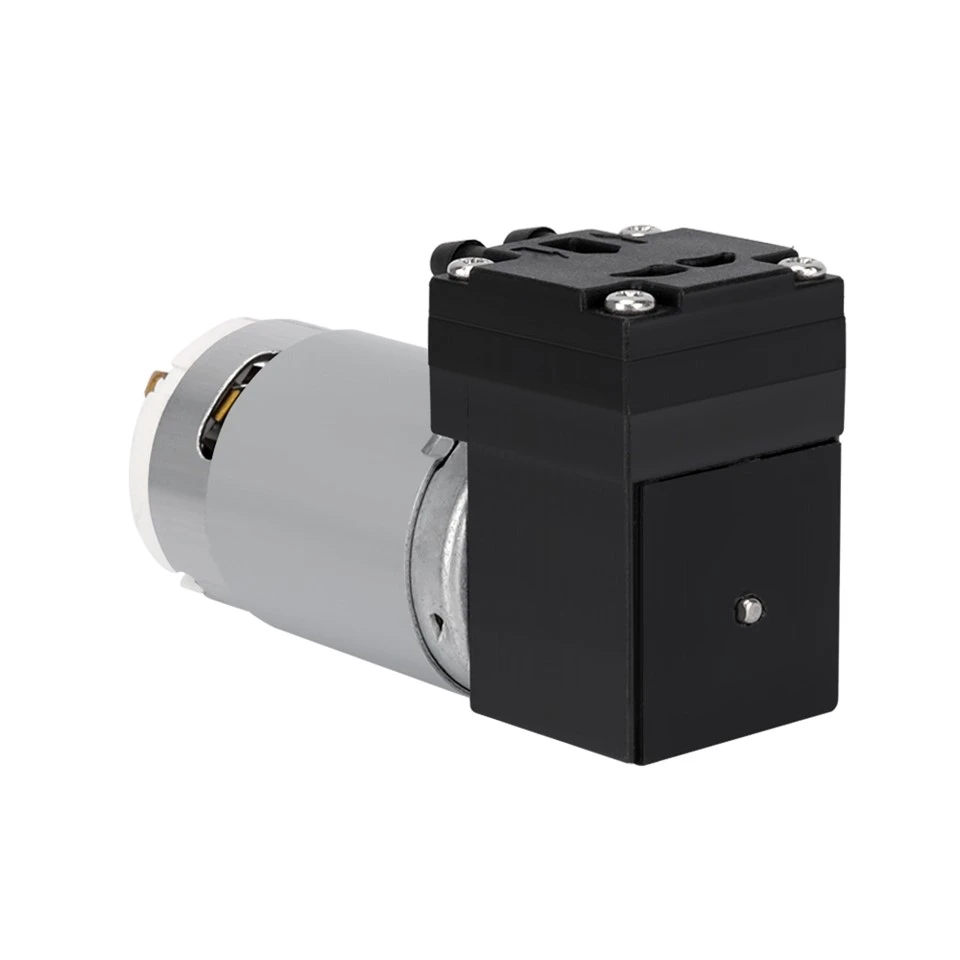


Products Description
At its core, a mini electric vacuum pump does one job: convert electrical input into a controlled negative pressure output, consistently, cycle after cycle. What separates a pump that survives 5,000 hours in the field from one that fails at 500 is almost never the headline spec sheet - it's the diaphragm material, the motor bearing quality, and how tightly the manufacturer holds tolerances across a production batch.
Our mini electric vacuum pump uses a fluorosilicone or NBR diaphragm (selected based on the media and chemical exposure your application involves) paired with a sealed micro DC motor rated for continuous or intermittent duty, depending on the model variant you choose. The housing is a glass-fiber-reinforced engineering plastic, chosen for dimensional stability under repeated thermal cycling - a detail that matters more than most spec sheets let on, because plastic housings that flex under heat are one of the quieter causes of long-term seal failure.
Typical integration points include:
Portable medical suction and sampling devices, where consistent vacuum level at low noise is non-negotiable
Handheld beauty and skincare instruments (blackhead extractors, facial cleansing tools), where the pump has to fit inside a housing barely larger than the motor itself
Small-format vacuum sealing and packaging equipment, where cycle speed and duty cycle rating drive throughput
Laboratory sample collection and filtration setups, where flow rate stability affects test repeatability
Automotive and industrial sensor-assist circuits, where the pump runs as a supporting component rather than the main system
A mini electric vacuum pump built for one of these categories isn't automatically right for another. Duty cycle requirements, noise tolerance, and expected service life diverge sharply between a medical device running short bursts all day and a packaging line running near-continuous cycles for hours. That's why we configure the diaphragm compound, motor winding, and housing material differently across our product variants rather than selling one pump and calling it universal.
Dimensions
Physical footprint is usually the first filter in any sourcing conversation, because the pump has to fit inside a housing that was probably designed before the pump was chosen. Below are the standard dimensional specs for our current mini electric vacuum pump line. Custom dimensions within a limited range are available for qualifying order volumes.
|
Parameter |
Specification |
|
Overall length |
38–52 mm (model-dependent) |
|
Overall width / diameter |
24–32 mm |
|
Overall height |
20–28 mm |
|
Net weight |
35–65 g |
|
Air inlet/outlet diameter |
2.5 mm / 3.0 mm (barbed or push-fit) |
|
Mounting options |
Bracket, adhesive pad, or PCB-mount base |
The compact envelope isn't just a marketing point - it's a direct trade-off against motor size, and motor size directly affects both flow rate and noise output. Where we've kept the size advantage is in the diaphragm chamber geometry: a shorter, wider chamber lets us hold flow rate closer to a larger pump's output without stepping up to a bigger motor housing. If your device has a tight internal cavity, our engineering team can review your CAD file and confirm fit before you commit to a batch order.
Power Consumption
Power draw and pump performance are two sides of the same coin, and this is where a lot of sourcing decisions go wrong - buyers compare wattage numbers across suppliers without checking what flow rate and vacuum level those numbers were measured at.
|
Parameter |
Specification |
|
Rated voltage |
DC 6V / 12V / 24V (configurable) |
|
Rated current |
0.15–0.6 A (voltage-dependent) |
|
Rated power |
1.8–7.2 W |
|
Max vacuum level |
Up to -75 kPa |
|
Free flow rate |
1.5–5.0 L/min |
|
Duty cycle |
30% ED to continuous, model-dependent |
|
Noise level |
≤45 dB(A) at 1 meter |
Lower power draw matters most in two scenarios: battery-powered handheld devices where every milliamp affects runtime, and enclosed housings where heat dissipation is limited. On a typical 12V, 2.4W configuration running at 30% duty cycle, a device pulling power from a 2000mAh battery can expect several hours of intermittent operation before recharge - the exact figure depends on your device's full power budget, not the pump alone, so we'd rather walk through your actual use case than quote a single number that doesn't apply to your product.
Why Choose Us
There are a lot of mini electric vacuum pump suppliers who will send you a spec sheet that looks identical to ours. The difference shows up later, usually after the first few thousand units are in the field.
Batch consistency you can verify. We run diaphragm and motor sub-assembly QC checks at the batch level, not just on finished samples, so the pump you approve in a sample order matches the pump you receive at 10,000 units.
Life cycle testing with real data. Every model in our mini electric vacuum pump line goes through continuous-run life testing before release, and we can share the test report - including failure mode, not just a pass/fail summary - with buyers evaluating us for a first order.
Material transparency. We tell you which diaphragm compound, motor brand, and bearing type went into your specific configuration. If a supplier won't name these three things, they're usually not tracking them internally either, which tells you something about batch consistency down the line.
Engineering support before you order. If your application has an unusual mounting constraint, chemical exposure requirement, or duty cycle that doesn't match our standard variants, our team reviews the requirement before quoting rather than after.
We're not the only mini electric vacuum pump manufacturer who can hit these spec numbers on paper. What we've built our reputation on is holding those numbers steady from the first sample to the ten-thousandth unit.
FAQ
Q: What is a mini electric vacuum pump used for?
A: It's used anywhere a device needs a compact, low-noise source of negative pressure - common examples include portable medical suction tools, handheld beauty devices, small vacuum packaging machines, lab sampling equipment, and automotive sensor circuits.
Q: What's the minimum order quantity?
A: Standard MOQ starts at 500 units for existing configurations. Custom diaphragm material, voltage, or housing modifications typically require a higher MOQ due to tooling and validation costs - we'll confirm the exact number once we know your specification.
Q: Can the pump be customized for a specific device housing?
A: Yes, within a defined range. Send us your device's internal cavity dimensions and mounting constraints, and our engineering team will confirm whether it's a standard-variant fit or a custom-tooling situation.
Q: How long does the pump typically last in continuous use?
A: Life expectancy depends heavily on duty cycle and operating vacuum level. Intermittent-duty configurations are rated for tens of thousands of cycles under normal load; continuous-duty variants are tested separately for extended-run applications. We can share life cycle test data specific to your configuration on request.
Q: How noisy is the pump during operation?
A: Standard configurations run at or below 45 dB(A) measured at one meter, which is close to typical indoor ambient noise. Lower-noise variants are available for applications like handheld beauty devices where audible operation is a usability concern.
Q: What voltage options are available?
A: DC 6V, 12V, and 24V are our standard rated voltages. Each corresponds to a different current draw and power profile, so the right choice depends on your device's existing power supply rather than pump performance alone.
Q: Does the pump require maintenance?
A: There's no scheduled maintenance for the sealed motor housing. Diaphragm inspection is recommended after the rated cycle life is reached, particularly in continuous-duty applications, since diaphragm wear is the most common early failure signal.
Hot Tags: Mini Electric Vacuum Pump, China Mini Electric Vacuum Pump manufacturers, suppliers, factory, lng pump, gas at the pump, 100 gallon fuel tank with pump, fuel syphon pump, lpg filling pump, gas powered irrigation pump


